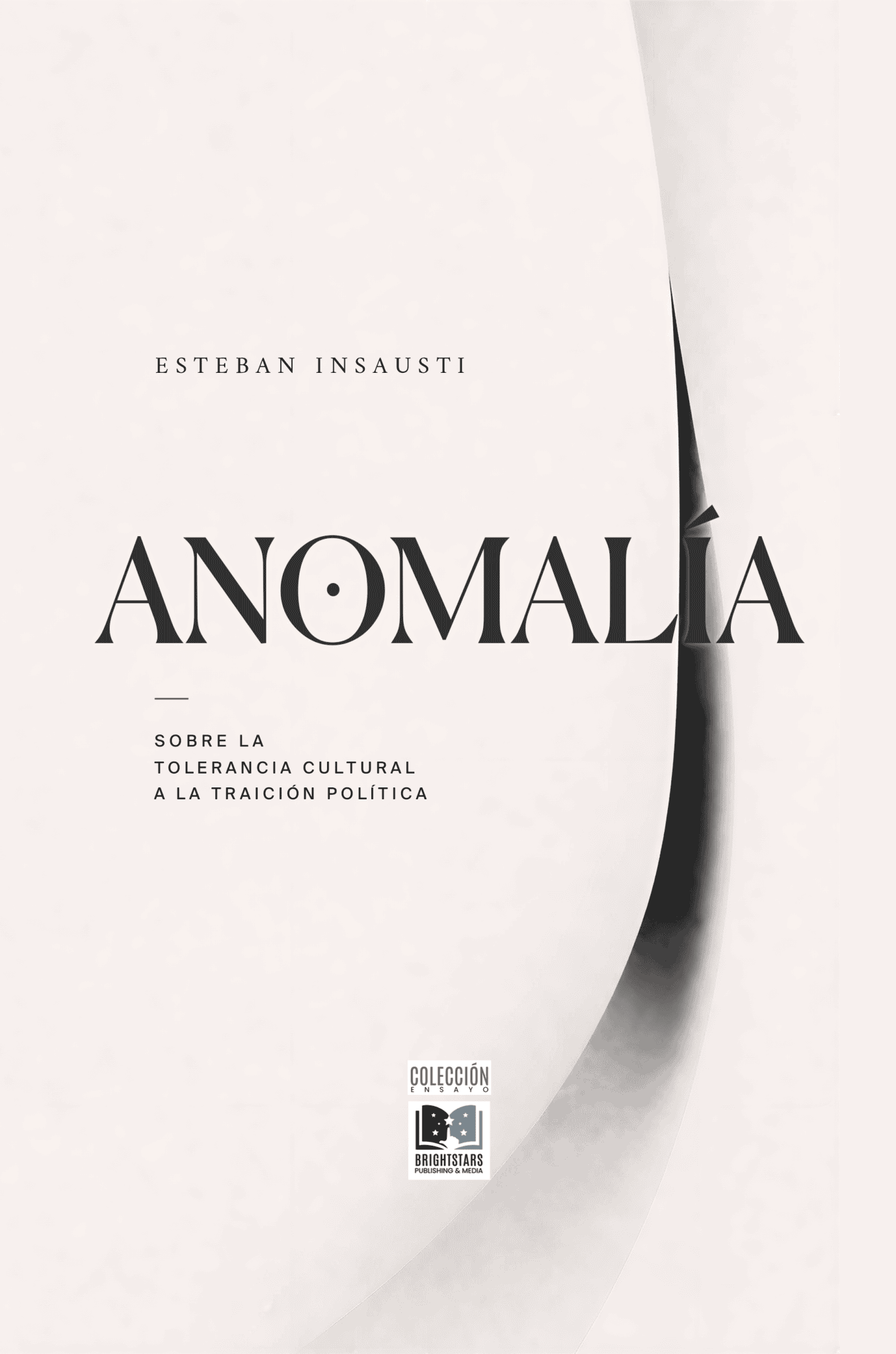
Anomalía. Sobre la tolerancia cultural a la traición política

Anomalía. On the Cultural Tolerance of Political Betrayal, by Esteban Insausti, is a political, cultural, and moral essay written through the eyes of a filmmaker. It does not emerge from the coldness of academic theory or the simplifying urgency of the pamphlet, but from an image: a landfill at dawn, crossed by the voice of Martin Luther King and his dream of universal justice. In that collision between democracy’s luminous promise and the material, ethical, and political waste produced by our time, the author finds the book’s central question: how have we learned to live with the intolerable?

From that foundational image, Insausti builds a reflection on corruption, demagoguery, digital populism, the banality of the vote, civic indifference, poverty as a political product, and the relationship between culture, power, and public responsibility. The anomaly that gives the essay its title is not only the betrayal of the politician who promises to serve and ends up plundering, manipulating, or degrading the common life. The most disturbing anomaly is the ability of societies to accept that betrayal, justify it, repeat it, and finally absorb it as part of the natural landscape.

The book engages with thinkers such as Hannah Arendt, Antonio Gramsci, George Orwell, Albert Camus, Frantz Fanon, Aimé Césaire, Paul Mason, Martha Nussbaum, Amartya Sen, and other major voices in contemporary political, cultural, and economic thought. But it does not do so to display erudition; it does so in order to think, from the present, through an urgent question: what kind of citizenship does a democracy need in order not to become an empty ceremony?

With intense, visual, and essayistic prose, Anomalía examines contemporary forms of electoral authoritarianism, politics turned into spectacle, the citizen reduced to a spectator, the economic capture of institutions, and the role of culture as a space of resistance, memory, and civic reconstruction. Against cynicism and resignation, the book does not propose a naïve utopia, but rather a demand: to recover the ability to name, to look, and to respond.

This is an essay for readers interested in politics, democracy, culture, Latin America, Cuba, critical thought, and civic responsibility. An uncomfortable, necessary, and deeply timely book about the distance between what societies promise to be and what they are willing to tolerate.

Additional information

Weight 250 g
Dimensions 6 × 9 in
Autor

Esteban Insausti

Pages

268

Collection

Ensayo

Genres

Political Essay

Language

Spanish

ISBN Paperback

978-1-968878-15-3

ISBN Hardcover

978-1-968878-16-0

Library of Congress Control Number

2026948755

Description

Anomalía. On the Cultural Tolerance of Political Betrayal, by Esteban Insausti, is a political essay written through the eyes of a filmmaker: visual, ethical, unsettling, and deeply civic. From a powerful image —a landfill at dawn set against Martin Luther King’s dream of universal justice— the author asks how we have learned to live with the contradiction between the democratic ideals we proclaim and the political, economic, and cultural realities we tolerate. The anomaly is not only the corruption of power, demagoguery, or the betrayal of the public representative; above all, it is the capacity of societies to normalize what should be intolerable.

With essayistic prose of strong literary pulse, Insausti engages with thinkers such as Hannah Arendt, Antonio Gramsci, George Orwell, Albert Camus, Frantz Fanon, Aimé Césaire, Paul Mason, Martha Nussbaum, and Amartya Sen to examine electoral authoritarianism, digital populism, the banality of the vote, poverty as a political product, culture as a territory of resistance, and the possibility of imagining a freer, fairer, and more responsible society. It is neither a pamphlet nor an academic monograph. It is an appeal to the contemporary citizen. A book about power, culture, memory, public responsibility, and democratic hope in an age marked by cynicism, inequality, and institutional fatigue.

Anomalía invites us to look directly at what habit has taught us to accept.

Reviews

There are no reviews yet.

Be the first to review “Anomalía. Sobre la tolerancia cultural a la traición política”

Your email address will not be published. Required fields are marked *

Go to Top
E-mail
Password
Confirm Password
Anomalía. Sobre la tolerancia cultural a la traición política
Secret Link
E-mail
Password
Confirm Password